


By Amy Saffell
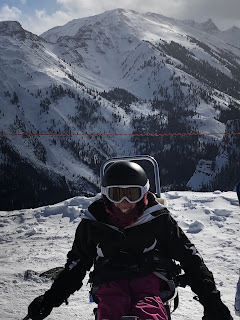
If you don’t know much about adaptive skiing, the first thing to know is that there is a way for everyone to ski. For people who ski sitting down, there are mono-skis, which have one ski below where you’re seated and are for people with good balance, and bi-skis, with two skis below you for more stability. Most of the time, you also have outriggers, the top part like a crutch and the bottom like a ski, which help with turns and balance. You can hold outriggers in your hands or they can be fixed to your ski if you don’t have the grip strength to hold them. You can also ski with assistance without any outriggers at all. Also, when you’re first learning and for as long as you need it, you can be tethered to your instructor, which enables he or she, to help you make turns and, most importantly, control your speed.
 |
| Amy on the bi-ski |
Warmth is often a concern for new adaptive skiers. I’m a Southerner, warm-weather girl normally, but getting to ski is different. Depending on where and what time of year you ski, you do have to pay attention to the kinds of fabrics you wear to keep you warm. However, especially if you’re going to control your own outriggers, remember that skiing can be hard work, and, as a result, you do warm up. There are lots of great guides for what to wear if you search online.

As for my own skiing experiences, I started out in a mono-ski the first time that I skied. I went into skiing knowing that I didn’t have the best balance, but other people on my trip were in mono-skis, so when it was suggested to me, I gave it a whirl. It was definitely a challenge! I was fighting my balance the whole time to stay up, but, honestly, I went into it with low expectations, so I was pretty happy that I stayed up at all. On my first trip, I also learned how important it was to jive with your instructor. From what I gathered, my instructor was more used to working with standing skiers with other types of disabilities and with people at a more advanced level of skiing than me. I’ve absolutely loved all of my other instructors who I’ve had over the years and know my first instructor pairing was just a fluke, but it was all so new to me that I was still able to take it all in and have fun.

When you spend most of your life 4 feet off the ground, being on top of a mountain is a pretty incredible feeling. The scenery as you ski and the feeling of having made it down the mountain are pretty awesome, too. It’s something that words don’t always do the proper justice, so take some time to head over to the slopes and experience it for yourself.
About the Author:
Columnist Amy Saffell lives in Nashville, TN and is the Executive Director of ABLE Youth, a nonprofit that helps kids with physical disabilities learn to be independent focusing adaptive sports. She enjoys participating in races anywhere from 5Ks to half marathons, climbing, spending time with friends and family, concerts, and finding new adventures.
Columnist Amy Saffell lives in Nashville, TN and is the Executive Director of ABLE Youth, a nonprofit that helps kids with physical disabilities learn to be independent focusing adaptive sports. She enjoys participating in races anywhere from 5Ks to half marathons, climbing, spending time with friends and family, concerts, and finding new adventures.
No comments:
Post a Comment
We would love to hear from you! Please become a member to comment. Thank you!
Note: Only a member of this blog may post a comment.